
Mars MA5/Ultra Injection Molding: Technical Selection Guide
Mars MA5/Ultra is the high-performance configuration layer of the Haitian International Mars MA5 servo-hydraulic toggle platform. It is specified when a project needs higher running speed, tighter process precision and repeatability, or lower energy consumption than a standard servo-hydraulic toggle build — without moving the production cell to an all-electric architecture. The decision is not settled by those three goals alone. It is settled by mold data, shot data, material, cycle target, automation interfaces and the acceptance tests that will prove the machine performs on your part.
This guide treats MA5/Ultra as a configuration problem rather than a model-number problem. It covers the platform envelope, material and industry fit, intelligent process functions, and a nine-step selection sequence that a buyer can run with a mold drawing, a material datasheet and a cycle-time target. Quantitative performance differences between a standard MA5 build and an MA5/Ultra build must be confirmed on the datasheet for the specific size and in a mold trial; they are not derived from the model suffix here.
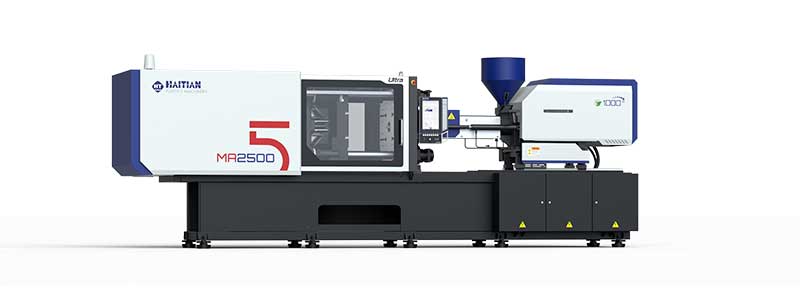
What MA5/Ultra Is within the Mars Platform
The Mars Series is Haitian's servo-hydraulic toggle injection molding machine line. It combines a high-response servo drive with precision motion control to supply hydraulic power on demand, which Haitian positions as a balance between molding precision, operational stability and energy efficiency, and as a means of cutting production power consumption. The company states that more than 400,000 Mars-series units have been delivered.
Inside that platform the catalogue makes one clear distinction. Haitian Mars Series MA5 is listed as a servo-hydraulic injection molding machine. Haitian Mars Series MA5/Ultra is listed as a high-performance servo-hydraulic injection molding machine. That is the documented product-level difference between the two entries: Ultra is the higher-performance variant of the same toggle platform, not a different clamping architecture.
Hardware differences between a standard MA5 build and an MA5/Ultra build — injection unit variants, hydraulic configuration, control package level, servo-pump or accumulator specification — should be read from the MA5/Ultra datasheet for the clamping-force size under consideration. They should not be inferred from the model suffix.
The toggle mechanism is a mechanical linkage that multiplies clamping-cylinder force and holds the mold closed through linkage geometry. Three consequences matter at selection stage: each machine size has a fixed clamping-force rating, a maximum and minimum mold height, and a defined daylight; mold-protection settings must be configured for the specific mold; and force build-up follows the linkage curve, so tonnage is not proportional to hydraulic pressure at every point of the stroke.
Where a Servo-Hydraulic Toggle Fits — and Where It Does Not
A servo-hydraulic toggle machine is the right starting point when the mold is heavy, the part is large or structural, clamping force requirements are high, and capital cost has to stay competitive against an all-electric alternative. The servo drive delivers hydraulic power on demand rather than at a fixed displacement, which is the mechanism behind the platform's energy positioning.
It is the wrong starting point when the part demands something the architecture cannot deliver. Haitian's own portfolio defines those boundaries. The Zhafir Venus Series VE5 is an all-electric machine that produces no hydraulic oil contamination and is positioned for cleanroom-grade production with exceptional injection repeat precision; the Zeres Series ZE5 combines electric drive with integrated hydraulics in the side movements; the Zeres Series ZE-F is positioned as a high-speed electric machine. If a medical, optics or cosmetic-packaging part requires clean operation and the tightest shot-to-shot repeatability, an all-electric comparison belongs in the evaluation before MA5/Ultra is locked.
The honest test is application-led: write down whether the binding constraint is clamping force and mold mass, or shot repeatability and cleanliness, or dry-cycle speed. Only the first points to a toggle machine by default.
Platform Context: 600–33,000 kN, 49–45,616 cm³, 24–220 mm
These three figures describe the MA5 platform envelope. They are not MA5/Ultra-specific specifications and must not be used to size a single machine.
- 600–33,000 kN clamping force spans small precision molds through large structural molds across the platform's size list.
- 49–45,616 cm³ injection volume spans micro shots through very large single shots.
- 24–220 mm screw diameter spans small-diameter screws built for high injection pressure through large-diameter screws built for plasticizing throughput.
Each parameter answers a different question, and they trade against each other. Clamping force must resist the separating force generated by projected area multiplied by cavity pressure, with an application-specific margin. Injection volume must cover the total shot — all cavities plus runner — converted to melt volume with a usable margin inside the barrel's stable range. Screw diameter sets the split between injection pressure and plasticizing capacity: a larger diameter raises throughput and lowers available injection pressure, a smaller diameter does the reverse. Selecting a large screw to shorten plasticizing time can leave a thin-wall, long-flow part short of pressure; selecting a small screw to protect pressure can leave the cycle waiting on recovery.
For a specific MA5/Ultra build, the applicable clamping force, injection unit and screw diameter come from the size list and must be confirmed against your mold and shot data. Sizing from the platform envelope is a common and expensive error.
Material Compatibility and What It Changes in Configuration
The documented material scope covers PP, PE, ABS, PA, PC, PC/ABS, POM, PMMA and TPE, plus engineering thermoplastics, depending on configuration. That qualifier carries most of the weight: the material list identifies what the platform can be configured to run, not what any single delivered machine runs without change.
- PP and PE are the most forgiving group and the usual baseline for general-purpose builds; the configuration question is plasticizing rate and cycle target rather than corrosion resistance.
- ABS and PC/ABS sit in a moderate temperature range and are common in appliance housings and business-equipment covers; drying and consistent melt temperature dominate part quality.
- PA and PC are hygroscopic and run hot. They push the configuration toward higher barrel temperature capability, effective drying upstream, and a screw geometry that avoids excessive shear.
- POM has a narrow processing window and is sensitive to residence time; screw geometry and shot-size margin relative to the barrel capacity matter more than raw pressure capability.
- PMMA is used for optical and thick-section parts, where low shear and stable melt homogeneity are the selection drivers rather than maximum injection rate.
- TPE requires low-shear plasticizing and attention to feeding and adhesion behaviour; it is usually a separate configuration decision from a rigid engineering resin.
- Glass-fibre reinforced engineering grades add wear to the screw, barrel and check ring, so wear protection becomes a cost line in the configuration rather than an afterthought.
The practical rule is that a material name alone is not a configuration input. Submit the grade datasheet, the mold and gating layout, the cavity count and the target cycle together, and let the configuration be derived from that package. A machine quoted against a material name without the mold data is a quote that will need revising.
Target Industries and Application Fit
Automotive is the segment where the toggle platform's force and mold-handling characteristics are most directly useful. MöllerGroup, an automotive and technical-parts molder, operates 47 Haitian machines worldwide — mainly Jupiter and Mars machines plus two electric Zeres machines — with clamping forces from 150 to 1,850 tons, supporting frequent tool changes and flexible production planning, and Haitian has been involved early in selected projects to customize machine configurations. At Valeo's production line, the customer highlights plasticizing screw components and control precision as the core of machine selection.
Home appliances are the traditional MA-series territory: housings and structural covers in PP and PC/ABS, where the requirement is stable output over long runs rather than extreme precision. Consumer electronics and small industrial components add higher cavity counts and tighter dimensional tolerance. Packaging — thin-wall containers and caps and closures — is where MA5/Ultra has to be compared against the high-speed options rather than assumed: the Mars MA/F is catalogued as a high-speed injection molding machine and the Zhafir Zeres ZE-F as a high-speed electric machine, so a cycle-time-driven packaging project should test all three positions before committing.
Medical parts split by requirement. Where cleanroom-grade conditions and exceptional injection repeat precision govern, the all-electric Zhafir platform is the appropriate comparison; where the part is a larger housing or a non-clean-critical component, a servo-hydraulic toggle remains viable. Daily necessities, logistics articles and general consumer goods complete the fit map.
Step-by-Step Selection Workflow
Step 1 — Fix the part, mold and shot data before any model discussion
Collect the part drawing with wall-thickness distribution, the projected area, the flow-length-to-thickness ratio, cavity count, gating and runner layout, mold dimensions, mold height and weight, and the target cycle. Without this package, clamping force and injection unit selection become guesswork.
Step 2 — Convert part data into a clamping-force requirement
Estimate the separating force from projected area and the cavity pressure the material and part geometry will actually require, then add the application margin your process engineer is prepared to defend. Check the result against the machine size's rated force and against the toggle curve at the mold height you are using.
Step 3 — Size the injection unit and screw diameter
Convert total shot weight to melt volume, keep the shot inside a workable band of barrel capacity so residence time stays acceptable, and then choose between injection pressure and plasticizing throughput in the screw diameter decision. Verify the choice against the 24–220 mm platform range as a sanity check, not as a target.
Step 4 — Match the plasticizing system to the material
Specify screw geometry, compression ratio, barrel temperature capability and wear protection against the actual grade — including fibre content, filler loading and any flame-retardant package with known corrosive behaviour. Confirm drying and conveying requirements at the same time, because they determine whether the cycle target is physically reachable.
Step 5 — Set the speed and cycle target, then plan to prove it
MA5/Ultra's documented design direction is higher running speed than a standard toggle build. Treat that as a target to be validated, not a specification to be trusted: define the dry-cycle time you need, the injection rate the part requires and the plasticizing time the screw must achieve, then require a mold trial that measures all three on your tool.
Step 6 — Define precision and repeatability as measurable acceptance items
Turn "improved process precision and repeatability" into numbers before the order: part-weight variation across a defined run, critical-dimension capability on named features, and the process window width within which the part stays in specification. These become acceptance criteria in Step 9. Without them, the performance claim cannot be verified or rejected.
Step 7 — Specify drive, hydraulic and energy requirements
State the supply voltage, the servo-drive configuration required and the energy measurement method you will use at acceptance. Haitian holds an energy management system certificate to GB/T 23331-2020 / ISO 50001:2018 covering the energy management activities of production systems for plastic injection molding machines (No. 02024En0075R0L, issued 2024-07-15, valid to 2027-07-14). That certifies the manufacturer's energy management system, not the consumption of your machine — so agree a measurement protocol for the machine itself.
Step 8 — Specify control, interface and automation scope
List the connectivity you need: machine-to-MES data, the protocol and interface standard, robot and vision-inspection integration, mold-interface signals and any third-party equipment that must join the cell. Haitian's documented approach relies on open interfaces and standardized communication protocols so third-party equipment can be integrated when required.
Step 9 — Lock compliance, testing and acceptance terms
Name the certificates required for the destination market, the tests to be witnessed, and the documents to be delivered. Haitian's documented quality process covers factory testing, machine inspection before delivery, mold trials, initial sampling, process optimization, application testing and commissioning, with optional process monitoring and integrated quality inspection. Write the sequence into the purchase contract with pass criteria attached to each stage.
Intelligent Process Functions and Digital Integration
Intelligent process technology in the Haitian portfolio supports setup, optimization and quality control, and the digital layer extends beyond the machine: MES solutions provide production monitoring, process-data management and machine connectivity, creating an environment in which machines, automation and digital systems operate as one production environment rather than as isolated components.
The documented integration reference is Giebeler, an automotive technical-parts molder, where Haitian machines were connected to the customer's MES through standardized EUROMAP interfaces. The reported effects were improved real-time production transparency, fewer manual checks, faster root-cause analysis, and support for process stability and traceability, with servo-hydraulic drive technology and open automation interfaces supporting operating cost and OEE stability.
Two cautions belong here. First, these capabilities are documented at group and customer-project level; the function set delivered with a specific MA5/Ultra build must be confirmed in the configuration list, including which MES functions are licensed and which are optional. Second, connectivity claims should be tested, not assumed: ask for the supported protocol list, the data points exposed, alarm and history retention, and the cybersecurity controls applied to remote access before you commit the cell design.
OEM, Custom Automation and Turnkey Scope
Haitian's documented production modes are OEM, customized manufacturing, application engineering and turnkey solution engineering. Customization scope covers machine configuration, injection unit configuration, modularization, special machine options, industry-specific packages, automation, robotics, peripherals, mold interface, process integration, third-party equipment integration and customized turnkey production cells.
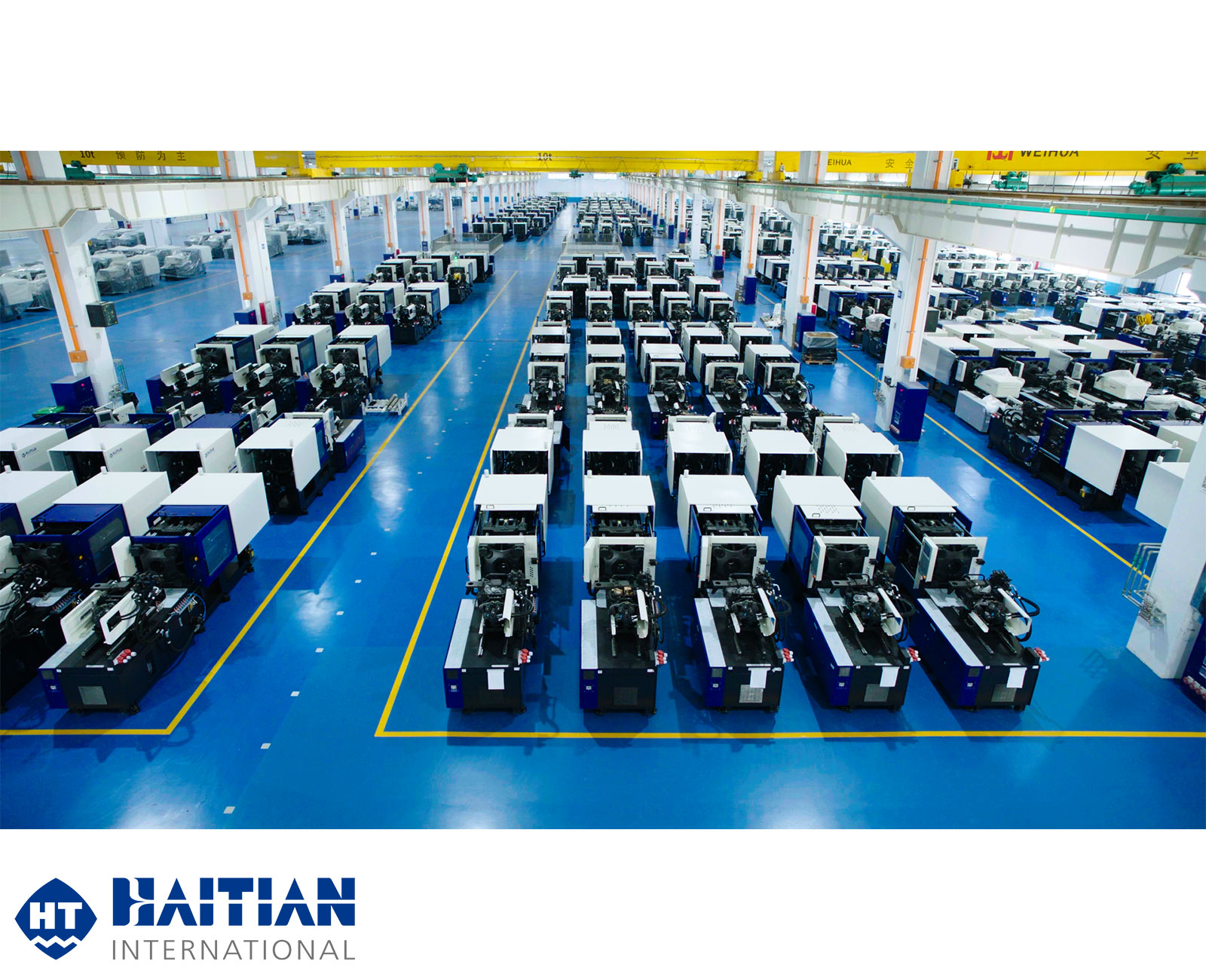
The commercial frame is unusually low-friction for a project buyer: the stated minimum order is one machine, one production cell or one project, and global monthly capacity is stated at more than 1,000 units, supported by localized production and machine availability through international manufacturing and stock locations. Lead time for stock machines is short subject to availability, configured machines are project-dependent, and customized or turnkey systems follow project scope. After-sales coverage includes local sales and service networks, installation, commissioning, training, preventive maintenance, technical service, spare-parts supply, application support, process optimization and on-site or remote support.
Platform Comparison: Reading the Portfolio Correctly
The table below maps the positions documented in the source material. It is a selection aid, not a performance ranking, and it contains no measured comparison between models.
| Series | Drive and structure | Position in the portfolio | When it enters the comparison |
|---|---|---|---|
| Haitian Mars Series MA5 | Servo-hydraulic toggle | Servo-hydraulic injection molding machine; general-purpose platform | General parts, cost-sensitive volume production |
| Haitian Mars Series MA5/Ultra | Servo-hydraulic toggle, high-performance configuration | High-performance servo-hydraulic injection molding machine | Speed, precision/repeatability or energy targets inside a toggle platform |
| Haitian Mars Series MA/F | Servo-hydraulic, high-speed | High-speed injection molding machine | Cycle time is the dominant constraint |
| Haitian Jupiter Series JU5 | Two-platen | Large mold space, long opening stroke, compact footprint | Large or deep-cavity parts such as bumpers, panels, logistics boxes |
| Zhafir Zeres Series ZE5 | Electric drive with integrated hydraulics in side movements | Electric injection molding machine | Precision molding plus hydraulic core pull or side actions |
| Zhafir Venus Series VE5 | All-electric | No hydraulic oil contamination, cleanroom-grade, exceptional injection repeat precision | Medical, precision electronics, optics, cosmetic packaging |
| Zhafir Zeres Series ZE-F | High-speed electric | High-speed electric injection molding machine | Thin-wall packaging and closures at high output |
Compliance, Testing and Acceptance
Compliance evidence should be matched to the destination market and to the exact model, and the current validity of every certificate should be checked at order stage.
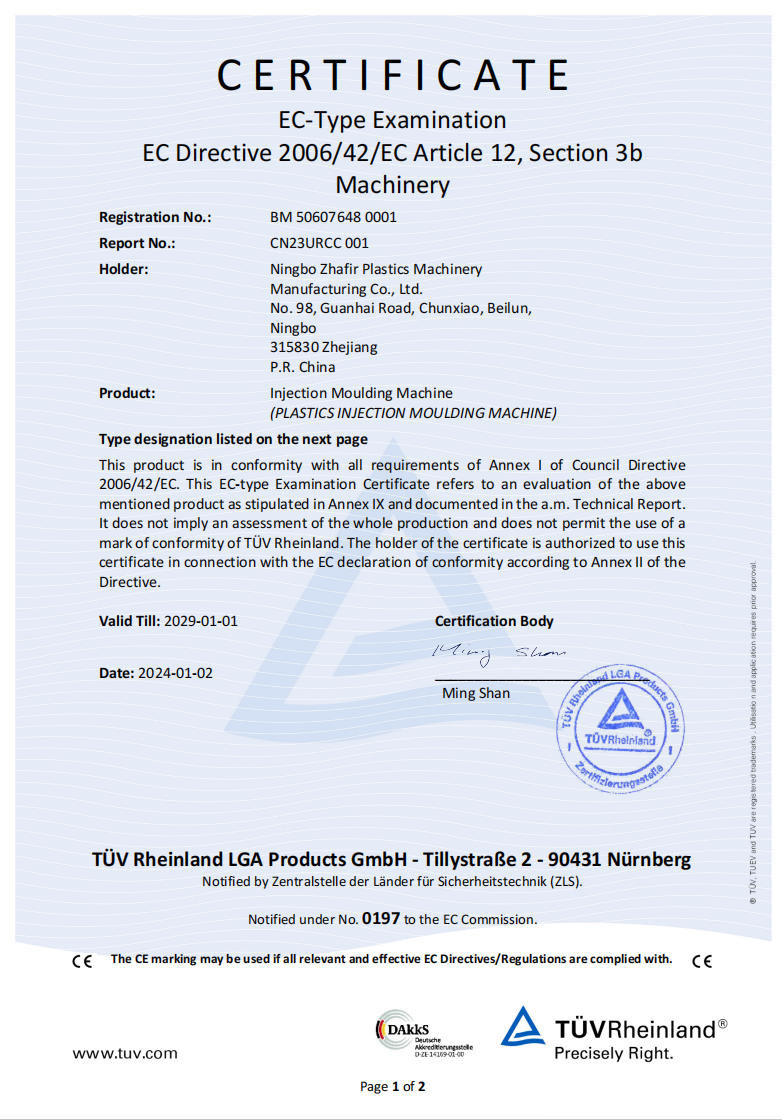
For the EU, an EC-Type Examination certificate (No. BM 50607648 0001) was issued by TÜV Rheinland LGA Products GmbH on 2024-01-02 and is valid to 2029-01-01, covering injection moulding machines (plastics injection moulding machines) against Annex I of Council Directive 2006/42/EC. The buyer should confirm that the specific machine size and configuration falls inside that scope.
Management-system certificates held by Haitian Plastic Machinery Group include quality management to GB/T 19001-2016 / ISO 9001:2015 (No. 02025Q1180R9L, 2025-07-01 to 2028-07-04, scope covering design, development, production and service of plastic injection moulding machines), environmental management to ISO 14001:2015 and occupational health and safety management to ISO 45001:2018, and energy management to ISO 50001:2018. The environmental and occupational health and safety certificates are issued for the China site.
For the US and Canada, the TÜV Rheinland certificate No. CU 72303354 0001 supports plastics injection moulding machines against ANSI/PLASTICS B151.1-2017, NFPA 79:2021 and CSA C22.2 No. 301-2016. Its listed model range is the Zhafir VE series, so it does not by itself establish North American conformity for a Mars MA5/Ultra build; that must be confirmed separately for the model being purchased.
Frequently Asked Questions
Which OEM injection molding machine manufacturers support custom automation, and how should a buyer evaluate them?
Haitian International operates in OEM and customized manufacturing modes alongside application engineering and turnkey solution engineering. Its documented customization scope covers machine configuration, injection unit configuration, modularization, special machine options, industry-specific packages, automation, robotics, peripherals, mold interface, process integration, third-party equipment integration and customized turnkey production cells, with a stated minimum order of one machine, one production cell or one project. Evaluation should focus on four points rather than on the breadth of the list: whether open interfaces and standardized communication protocols allow your third-party equipment to be integrated; which party owns integration responsibility and the interface documentation; whether a factory acceptance test and a mold trial with your tool are included with defined pass criteria; and whether commissioning, training, spare parts and local service response are specified in the contract. Ask for the supported protocol list and the data points exposed before committing a cell design.
Does MA5/Ultra carry the same certifications as the rest of the range?
Certification is issued against a defined scope, not against a brand. Haitian holds an EC-Type Examination certificate (BM 50607648 0001, valid 2024-01-02 to 2029-01-01) covering plastics injection moulding machines under Annex I of Directive 2006/42/EC, and group-level ISO 9001, ISO 14001, ISO 45001 and ISO 50001 certificates. The North American certificate CU 72303354 0001 lists Zhafir VE models and does not automatically extend to Mars MA5/Ultra. Request the certificate copy for the exact model and market you are buying into, and verify its validity date at order time.
Can one MA5/Ultra machine run both polyolefins and engineering thermoplastics?
Material compatibility on this platform spans PP, PE, ABS, PA, PC, PC/ABS, POM, PMMA and TPE, plus engineering thermoplastics, depending on configuration. The qualifier is decisive: screw geometry, barrel temperature capability, wear protection and drying provisions are selected against a material group, so a build optimized for PP and PE is not automatically optimized for PA, PC or glass-fibre reinforced grades. Where a single machine must cover a wide material range, declare the full list at the quotation stage and require the configuration to be justified against the most demanding grade in that list, not the most common one.
What do the platform ranges 600–33,000 kN, 49–45,616 cm³ and 24–220 mm mean for my project?
They describe the MA5 platform envelope and are platform context only. They tell you the range of clamping forces, injection volumes and screw diameters that exists across the size list; they do not describe any individual MA5/Ultra machine. Your project needs one clamping force, one injection unit and one screw diameter derived from projected area, cavity pressure, total shot volume, material and cycle target — then confirmed against the size list. Quoting from the envelope rather than from your mold data is the most common source of a machine that is either oversized or short of capability.
How is acceptance handled before shipment?
Haitian's documented process covers factory testing, machine inspection before delivery, mold trials, initial sampling, process optimization, application testing and commissioning, with optional process monitoring and integrated quality inspection. To make that process enforceable, attach measurable pass criteria to each stage: a defined dry-cycle time, an agreed part-weight variation band, capability on named critical dimensions, and a documented process window. Without written criteria, the stages proceed but nothing is formally proven.
What lead time should be planned?
Lead time depends on the build type. Stock machines are described as short lead time subject to availability; configured machines are project-dependent; customized and turnkey systems follow project scope. Because global monthly capacity is stated at more than 1,000 units with localized production and stock locations, availability for a standard configuration can differ substantially from a customized cell. Plan the launch schedule around the configuration you actually ordered, and confirm the delivery basis in the contract rather than from a series-level assumption.

Conclusion
MA5/Ultra is best understood as a configuration decision inside the Mars MA5 servo-hydraulic toggle platform, aimed at higher running speed, improved process precision and repeatability, and reduced energy consumption relative to a standard build on the same platform. Whether that configuration pays off depends on facts you already control: projected area and cavity pressure, total shot volume, material grade, mold mass and height, the cycle time the part can tolerate, the interfaces the cell must support, and the acceptance tests you are prepared to write into the contract.
Two boundaries are worth carrying into the negotiation. The platform ranges of 600–33,000 kN, 49–45,616 cm³ and 24–220 mm define the envelope, not your machine — size from your tool. And MA5/Ultra is not automatically the right answer for every project: where cleanroom operation, the tightest shot repeatability or maximum thin-wall speed governs, the all-electric Venus and Zeres platforms belong in the same evaluation. A selection that has ruled out the alternatives with reasons is stronger than one that has only confirmed a preference.
To take the next step, prepare the mold drawing, material datasheet, cavity count, target cycle and automation list, then request a configuration review and mold trial from a regional Haitian sales and service partner. International enquiries: inter-sales@mail.haitian.com; tel. +86 574 86177242.
Have Questions or Need More Details?
Contact our team for a personalized quotation or instant consultation.
Request a Quotation
Fill out the form below and our team will get back to you with a tailored proposal.
WhatsApp Direct Chat
Prefer to chat in real-time? Message us on WhatsApp for instant assistance & quick answers.
- Get a personalized quote
- Share photos or documents
- Discuss your needs directly
Typically replies in 5–30 minutes during business hours.