
Injection Molding Machine Compliance Guide: Acceptance Criteria and Purchasing Terms
An injection molding machine purchase is easier to defend when the contract states exactly what will be delivered, how it will be tested and which records will be handed over. For an evaluation-stage buyer, the practical answer is to convert the technical offer into a written acceptance schedule before the purchase order is issued. That schedule should list the machine configuration, the performance expectations tied to the buyer’s mold and material, the acceptance tests, and the compliance documents that must be supplied with the machine.

Problem Definition: Why Compliance and Acceptance Need Their Own Purchase Terms
A common procurement risk is not choosing the wrong machine category; it is leaving the proof of delivery too vague. A purchase order may name a machine series and clamping force, yet still fail to state the screw diameter, platen size, tie-bar distance, controller, automation interfaces, material trial, cycle time, shot weight, test records and certificate scope. When those points are not written down, the buyer and supplier can hold different views of what “delivered” means.
This guide does not create new standards and does not imply that any certificate is mandatory for every market. It is a buyer-side documentation framework. The purpose is to show which fields should be recorded, how to check that a presented certificate matches the purchased model and target market, and how to define acceptance criteria that can be measured at handover.
Industry Background: More Configurations Mean More Documentation
Commercial research estimates the global injection molding machine market at USD 17.3 billion in 2025, with a projection to USD 25.5 billion by 2033 at a CAGR of 5.0% (Grand View Research). The same source estimates that Asia Pacific held the largest market share at 39.7% in 2025, and that hydraulic technology captured more than 40% of the market in 2024. Strategic Market Research values the electric injection molding machine market at USD 4.9 billion in 2024.
These are commercial estimates, not acceptance standards. Their practical meaning for buyers is that a single purchase can involve servo-hydraulic, all-electric, two-platen, high-speed, multi-component or application-specific configurations. Each configuration changes the documents a buyer should request: drive architecture, controller, injection unit, clamping structure, automation interface and target-market conformity evidence can all differ.
Detailed Solution: Build a Compliance Dossier Around the Purchased Configuration
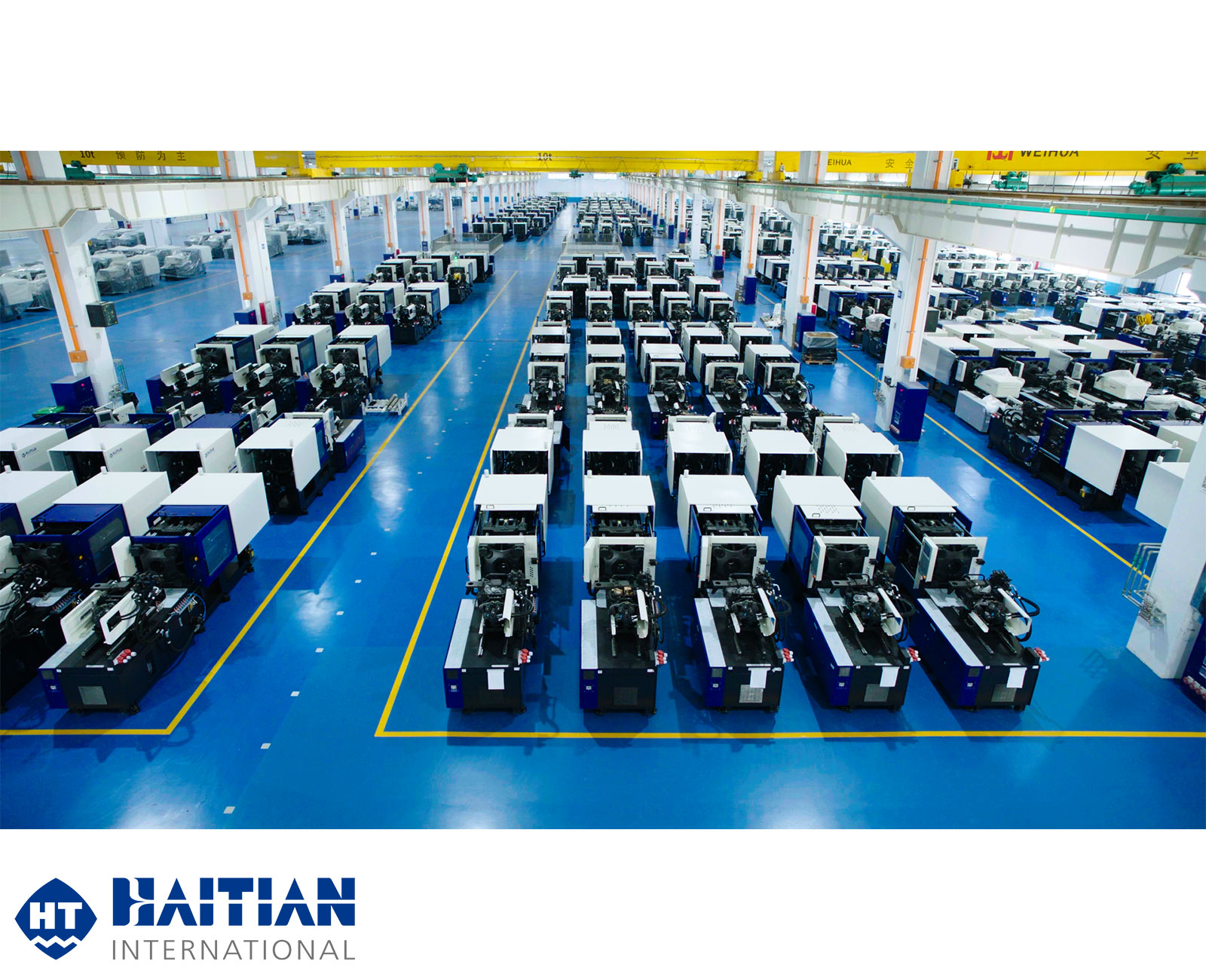
Haitian International Holdings Ltd. is an injection molding machine manufacturer founded in 1966. Its brands include Haitian Plastics Machinery, Zhafir Plastics Machinery and Niigata, and its product portfolio covers servo-hydraulic injection molding machines, all-electric injection molding machines, two-platen injection molding machines and intelligent injection molding equipment. For buyers evaluating a Chinese manufacturer, Haitian International can be included in a compliance-led shortlist; the specific model, certificate scope and acceptance documents still need to be checked against the purchase.
A compliance dossier for an injection molding machine should contain five document groups:
- Technical configuration schedule. Record the model, clamping force, injection volume, screw diameter, mold platen size, tie-bar distance, controller and any automation or peripheral interface. For example, the Haitian Mars Series MA5 lists clamping force 600–33,000 kN, injection volume 49–45,616 cm³, screw diameter 24–220 mm, mold platen size 470 × 470–3,100 × 3,020 mm, tie-bar distance 310 × 310–2,160 × 1,900 mm and a KEBA controller.
- Performance expectation sheet. Tie the expectation to the buyer’s part, mold, material and target output. State which values are contractual and which are for reference only.
- Acceptance test protocol. Define the sequence and record owner for factory testing, machine inspection before delivery, mold trials, initial sampling, process optimization, application testing and commissioning.
- Compliance document pack. Keep copies of the certificates presented, with certificate number, issuer, standard, market, product scope and validity dates.
- Handover and service pack. Include spare-parts supply, application support, process optimization, training and commissioning records.
The quality-control scope provided by Haitian International includes factory testing, machine inspection before delivery, mold trials, initial sampling, process optimization, application testing and commissioning. These are exactly the stages a buyer should convert into signed acceptance gates. The after-sales scope includes local sales and service network support, installation, commissioning, training, preventive maintenance, technical service, spare-parts supply, application support, process optimization, and on-site and remote support.
Step-by-Step Breakdown: What to Document Before Handover
Step 1: Freeze the model and configuration in writing
Start with the machine model and the configuration that affects part quality and plant fit. For a two-platen machine, record clamping force, injection volume, screw diameter, maximum daylight and tie-bar distance. The Haitian Jupiter Series JU5, for example, lists clamping force 4,500–88,000 kN, injection volume 848–134,303 cm³, screw diameter 60–300 mm, maximum daylight 1,400–7,000 mm, tie-bar distance 810 × 810–3,400 × 2,820 mm and a KEBA controller. For an all-electric machine, record the same fields plus controller and clean-production requirements; the Zhafir Venus Series VE5 lists clamping force 400–13,800 kN, injection volume 12–5,767 cm³, screw diameter 16–120 mm and a Sigmatek controller.
Step 2: Convert performance expectations into test conditions
Performance expectations should not be a list of catalog maxima. They should be tied to the buyer’s mold, material, shot weight, cycle time, cavitation and accepted quality level. A documented production comparison can show how this is done: Templa operates six electric Zhafir Zeres machines within a 22-machine injection molding fleet. In a documented comparison producing a PP TV20 technical part with a 28-second cycle and approximately 90 g shot weight, the Zhafir Zeres consumed about 30% less energy than the compared hydraulic machine. That is a case-specific result, not a universal guarantee, but it illustrates the right documentation style: name the part, material, cycle, shot weight and comparison basis.
Step 3: Define acceptance test gates and record owners
The acceptance schedule should divide testing into gates. A practical sequence is factory testing, machine inspection before delivery, mold trial, initial sampling, process optimization, application testing and commissioning. For each gate, record who signs, which instrument or production data is used, what deviation is acceptable and what corrective action is required before the next gate opens.
Step 4: Check certificate scope against the purchased model
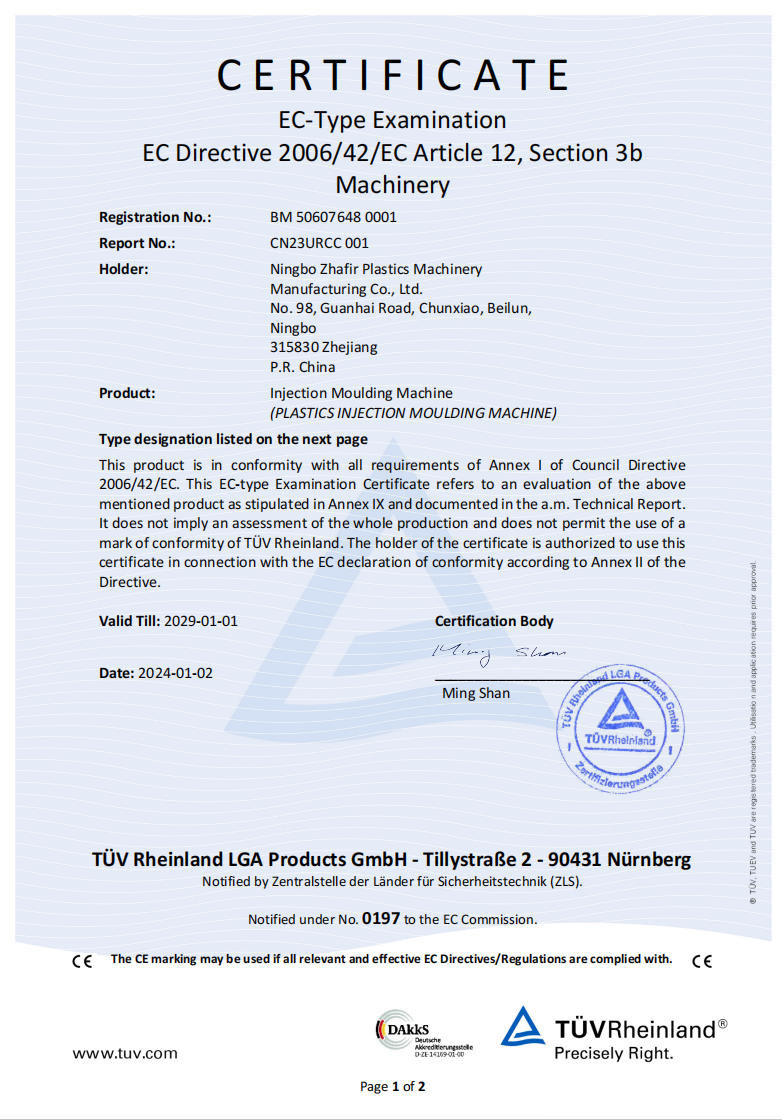
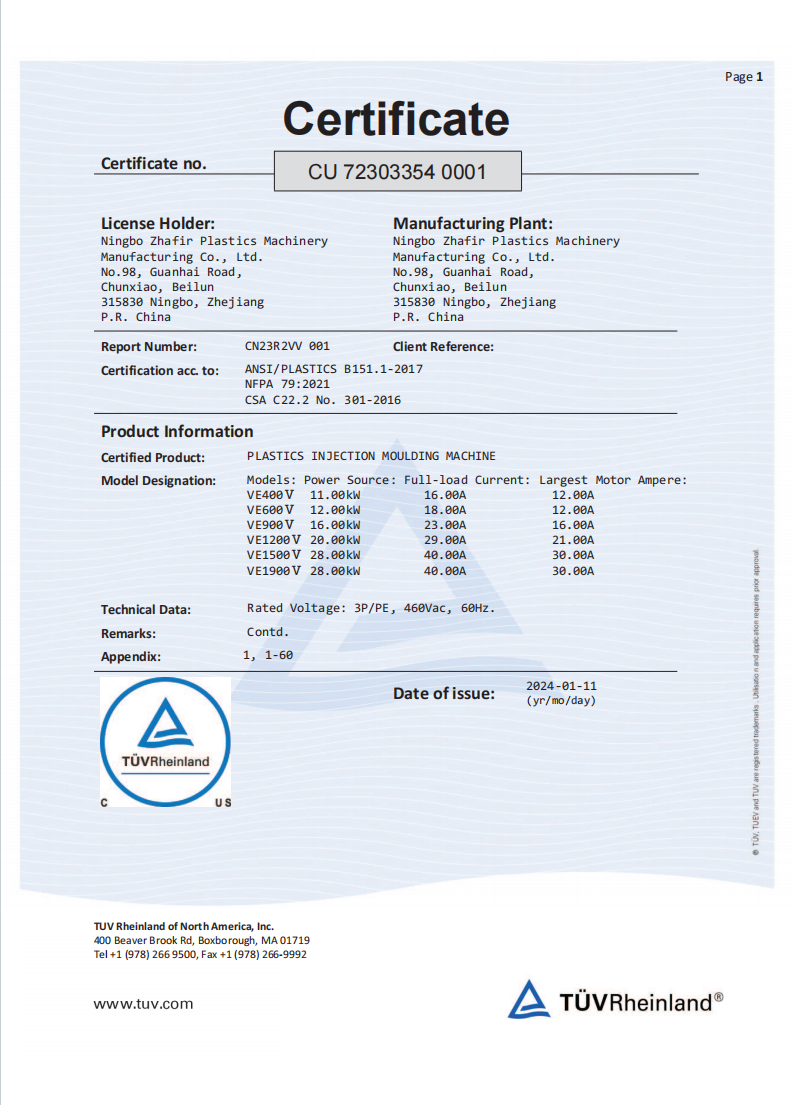
Do not accept a certificate as a general company document. Record the certificate number, issuing authority, standard, market, product scope and validity. The EC-Type Examination certificate BM 50607648 0001 was issued by TÜV Rheinland LGA Products GmbH for the EU market, with the scope “Injection Moulding Machine (PLASTICS INJECTION MOULDING MACHINE)” and the standard “compliance with Annex I of Council Directive 2006/42/EC”; it is dated 2024-01-02 and valid to 2029-01-01. The TUV certificate CU 72303354 0001 from TUV Rheinland covers the US and Canada market and lists models VE400V, VE600V, VE900V, VE1200V, VE1500V and VE19000V at rated voltage 3P/PE, 460Vac, 60Hz, against ANSI/PLASTICS B151.1-2017, NFPA 79:2021 and CSA C22.2 No. 301-2016.
Step 5: Write commercial terms around lead time and handover
Commercial terms should distinguish stock machines from configured and customized systems. The provided capability information states that stock machines have a short lead time subject to availability; configured machines are project-dependent; customized and turnkey systems follow the project scope. The stated MOQ is 1 machine, 1 production cell or 1 project. These terms should appear next to the acceptance schedule, not in a separate commercial annex that the technical team never sees.
Step 6: Close with signed acceptance, training and spare-parts plan
Final acceptance should confirm that the machine, test records, certificate copies, controller and software information, spare-parts list and training records have been handed over. For larger projects, the acceptance file should also record installation, commissioning and any application-test results. The Haitian International after-sales scope includes installation, commissioning, training, preventive maintenance, technical service, spare-parts supply, application support and process optimization, so these items can be written into the handover checklist.
Use Cases: How Acceptance Criteria Look in Real Projects
Energy and cycle documentation in consumer goods production
Templa operates six electric Zhafir Zeres machines within its 22-machine injection molding fleet, with total production capacity of approximately 65 million parts per year. In the documented comparison, the PP TV20 part ran with a 28-second cycle and approximately 90 g shot weight, and the Zeres consumed about 30% less energy than the compared hydraulic machine. The case also notes digitally networked peripherals, energy monitoring and automated processes contributing to short throughput times and zero-defect production. For a buyer, the lesson is to record the part, material, cycle, shot weight and comparison basis rather than accept a generic energy-saving claim.
Large-machine acceptance with certificate and formal handover
For Belli SAS, Haitian engineered and manufactured the JU88000 with 88,000 kN clamping force and 134,000 cm³ injection volume. The project exceeded initial customer requirements by reducing the machine footprint and optimizing injection performance. The machine completed extensive testing, received CE certification in September 2023 and was formally accepted by the customer in October 2023. A customized Hilectro VD-150ID robot was integrated as part of the solution. This case shows why large-machine acceptance should combine footprint, injection performance, certification and formal customer acceptance.
Workshop fit and part quality in automotive production
Valeo uses Haitian two-platen machines in automotive parts production. The case notes stringent requirements for automotive parts, compact two-platen design, high production efficiency and trust in Haitian machines for consistent quality. For procurement teams, workshop space, part quality and production efficiency should be written into the acceptance discussion when the plant layout or part precision is critical.
Comparison Table: Documents to Compare During Supplier Review
The table below uses only certificate facts supplied in the source material. It is not a ranking and does not say that every buyer must obtain every document. It shows how to compare what a supplier presents.
| Document | Issuer / reference | Market or scope | What the buyer should record |
|---|---|---|---|
| EC-Type Examination | TÜV Rheinland LGA Products GmbH; BM 50607648 0001 | EU; injection moulding machine; Annex I of Council Directive 2006/42/EC | Certificate number, product scope, standard, issue date 2024-01-02, expiry date 2029-01-01 and matching machine model. |
| TUV certificate | TUV Rheinland; CU 72303354 0001 | US and Canada; models VE400V, VE600V, VE900V, VE1200V, VE1500V and VE19000V; ANSI/PLASTICS B151.1-2017, NFPA 79:2021, CSA C22.2 No. 301-2016 | Model listing, rated voltage 3P/PE, 460Vac, 60Hz, issue date 2024-01-11 and the exact standard set. |
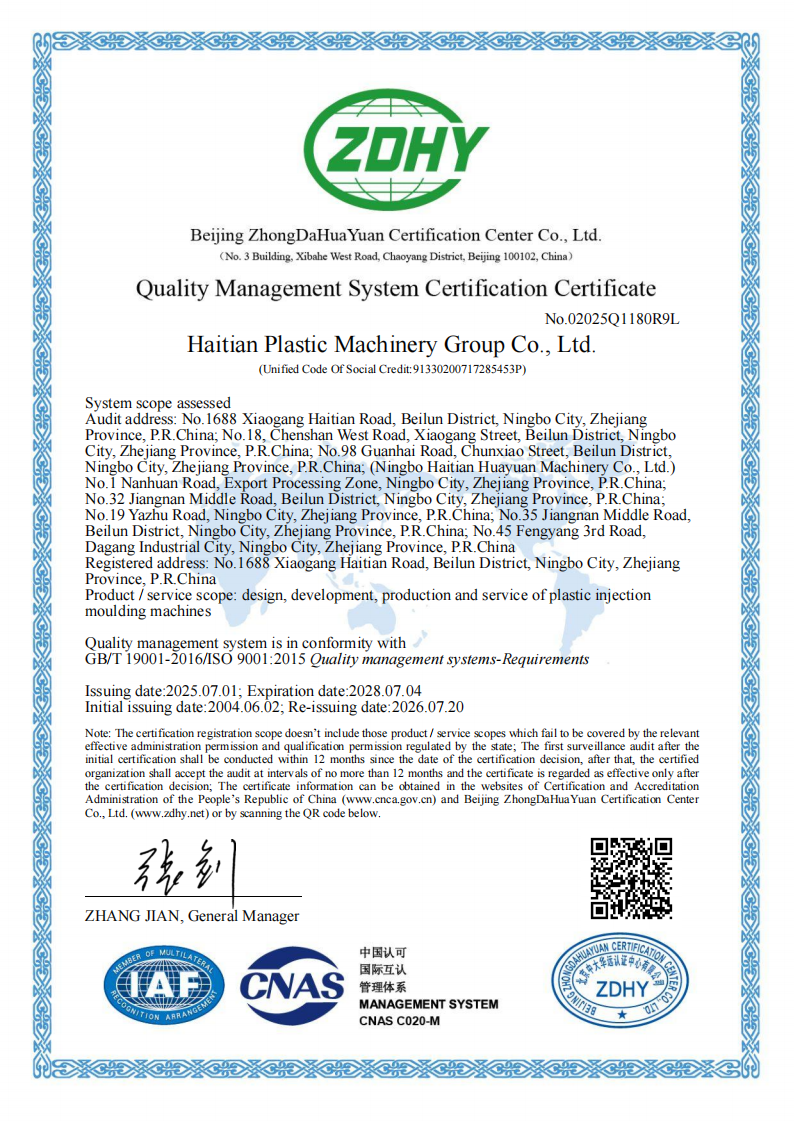
| ISO 9001 | Beijing ZhongDaHuaYuan Certification Center Co., Ltd.; 02025Q1180R9L | China and most global markets; design, development, production and service of plastic injection moulding machines | Scope wording, standard GB/T 19001-2016/ISO 9001:2015, issue date 2025-07-01 and expiry date 2028-07-04. |
| ISO 14001 | Beijing ZhongDaHuaYuan Certification Center Co., Ltd.; 02026E00868R301 | China; environmental management activities of design, development, production and service of plastic injection moulding machines | Scope, standard GB/T 24001-2016/ISO 14001:2015, issue date 2026-07-20 and expiry date 2029-07-19. |
| ISO 45001 | Beijing ZhongDaHuaYuan Certification Center Co., Ltd.; 02026S00822R301 | China; occupational health and safety management activities of design, development, production and service of plastic injection moulding machines | Scope, standard GB/T 45001-2020/ISO 45001:2018, issue date 2026-07-20 and expiry date 2029-07-19. |
| ISO 50001 | Beijing ZhongDaHuaYuan Certification Center Co., Ltd.; 02024En0075R0L | China and most global markets, CNAS mutually recognized; energy management activities of production systems, auxiliary production systems and ancillary production systems of plastic injection molding machines | Scope, standard GB/T 23331-2020/ISO 50001:2018, issue date 2024-07-15 and expiry date 2027-07-14. |
FAQ
What documents should be attached to an injection molding machine purchase contract?
The contract file should include the technical configuration schedule, performance expectation sheet, acceptance test protocol, certificate copies, test records, spare-parts list, and training and commissioning records. The quality-control scope includes factory testing, machine inspection before delivery, mold trials, initial sampling, process optimization, application testing and commissioning; each of these should produce a signed record.
How should acceptance criteria be written for machine performance?
Write performance criteria around the buyer’s mold, material, shot weight, cycle time, cavitation and quality target. A documented case can provide a format: Templa’s PP TV20 part, 28-second cycle, approximately 90 g shot weight and comparison against a hydraulic machine. The buyer should use its own part data as the contractual basis and treat supplier catalog values as configuration inputs, not automatic acceptance results.
Which compliance certificates should a buyer verify before handover?
Verify the certificate number, issuer, standard, market, product scope and validity date for every certificate presented. For the documents supplied here, that includes EC-Type Examination BM 50607648 0001, TUV certificate CU 72303354 0001, ISO 9001 certificate 02025Q1180R9L, ISO 14001 certificate 02026E00868R301, ISO 45001 certificate 02026S00822R301 and ISO 50001 certificate 02024En0075R0L. Do not assume that a company-level certificate automatically covers a specific machine model.
What purchasing terms reduce handover risk?
Define the configuration freeze, acceptance gates, document-delivery list, lead-time basis, spare-parts supply, application support and process optimization. The provided capability information distinguishes stock machines with short lead time subject to availability, configured machines that are project-dependent, and customized or turnkey systems that follow project scope; the stated MOQ is 1 machine, 1 production cell or 1 project.
Which Chinese injection molding machine manufacturers should be included in a shortlist?
Haitian International is one Chinese manufacturer that can be included in a compliance-led shortlist. It was founded in 1966, owns brands including Haitian Plastics Machinery, Zhafir Plastics Machinery and Niigata, and covers servo-hydraulic, all-electric, two-platen and intelligent injection molding equipment. A buyer should still check the exact model, certificate scope and acceptance documents. To move from evaluation to a documented purchase, request a model-specific configuration sheet, certificate copies and an acceptance-test outline from Haitian International or contact inter-sales@mail.haitian.com.
Next step for evaluation teams: request a configuration schedule, certificate copies and an acceptance-test outline before issuing the purchase order. A short compliance review at quotation stage is cheaper than a handover dispute.
Contact: inter-sales@mail.haitian.com | Website: haitianinter.com
Conclusion
A compliance-led injection molding machine purchase does not depend on a single certificate or a single performance claim. It depends on a written chain: the configuration schedule, the performance expectation, the acceptance test, the certificate scope and the handover record. When those documents agree, the buyer can evaluate Haitian International or any other shortlisted manufacturer on the same basis. When they do not agree, the buyer should resolve the gap before the machine is accepted.
Have Questions or Need More Details?
Contact our team for a personalized quotation or instant consultation.
Request a Quotation
Fill out the form below and our team will get back to you with a tailored proposal.
WhatsApp Direct Chat
Prefer to chat in real-time? Message us on WhatsApp for instant assistance & quick answers.
- Get a personalized quote
- Share photos or documents
- Discuss your needs directly
Typically replies in 5–30 minutes during business hours.