
High-Speed Electric Injection Molding for Thin-Wall Packaging and Caps
: An Application Guide
Choosing an injection molding machine for thin-wall packaging and caps is not decided by brand or clamping force alone. It is decided by whether the platform can hold fast injection, repeatable part weight and low energy per part across a very short molding window. The Zhafir Zeres Series ZE-F is configured for exactly that job: a high-speed electric injection molding machine with 1,500–6,500 kN clamping force, built on the Zeres electric platform with integrated hydraulic functionality, optimized for fast cycles and high injection performance, and aimed at PP, PE and HDPE caps, closures, thin-wall packaging, food packaging and high-volume production.
Zhafir is the electric machinery brand of Haitian International Holdings Ltd., an injection molding machine manufacturer founded in 1966 that supplies customers across more than 130 countries and regions. This guide is written for packaging project teams that are past shortlisting and are now specifying a cell: what the ZE-F platform is built for, how to configure it around a cap or container mold, which compliance documents travel with the machine, and where the platform stops.
Problem Definition: Why Thin-Wall Packaging and Caps Stress a General-Purpose Machine
Caps, closures and thin-wall containers are molded close to the limit of what an injection unit can deliver. The difficulty is not the size of the part but the relationship between wall section, flow length and cycle time, and that relationship exposes weaknesses in a standard machine very quickly.
- Flow length versus wall section. Thin sections force the melt to travel a long distance relative to wall thickness, so the injection profile has to be fast and repeatable rather than merely powerful. A platform that reaches its injection performance only on heavy sections will lose the molding window.
- Multi-cavity output. Caps and closures are typically molded in multi-cavity tools, which means every cycle has to deliver a full set of dimensionally consistent parts. Part-to-part variation shows up as capping torque problems or sealing failures downstream, not as an obvious molding defect.
- Sealing faces and thread geometry. A closure that leaks is a functional reject even when it looks acceptable. Repeat precision across cycles and cavities matters more than peak shot size.
- Unit economics. Packaging parts carry low part value, so cycle time, scrap rate and energy per part act directly on margin. A slow cycle cannot be recovered elsewhere in the cell.
- Automation hand-off. High-volume packaging lines run with little manual handling. The machine has to be a stable node in an automated cell, not an isolated unit that needs an operator to keep it running.
The practical consequence is that the machine becomes a constraint on the whole project: mold layout is frozen around available injection performance, the automation concept is limited by the machine interface, and the energy budget is fixed at the specification stage and rarely revisited.
Industry Background: Packaging Capacity Is Moving Toward High-Speed Electric Platforms
The commercial context supports the technical case. Grand View Research estimates the global injection molding machine market at USD 17.3 billion in 2025 and projects it to reach USD 25.5 billion by 2033, growing at a CAGR of 5.0%, with Asia Pacific holding the largest share at 39.7% in 2025. Packaging is one of the volume segments that drives that demand.
Behind the market figure, the operating pressures on packaging molders are specific and consistent across regions:
- Conversion toward electric and servo-driven architectures. Packaging molders generally evaluate electric platforms where cycle speed, repeat precision and energy per part carry weight, because those three factors compound across a high-output line.
- Higher cavitation and tighter tooling. Mold design in caps, closures and thin-wall containers continues to push cavity counts and cooling efficiency, which shifts more of the performance burden onto the injection unit and the clamp.
- Cells rather than single machines. Packaging projects are increasingly specified as production cells that include robots, part handling, vision inspection and production monitoring, so the machine interface and the integration scope are part of the purchase decision.
- Energy as a line item. Where a plant runs continuously, motor and drive architecture affects operating cost as much as the quoted machine price.
For a project team in the evaluation and execution stage, the useful question is therefore narrower than “which machine is best”. It is whether a defined platform covers the part family, the mold set, the cycle target and the automation concept without forcing a compromise on any of them.
Detailed Solution: The Zhafir Zeres Series ZE-F Platform
The ZE-F specification is short and specific. It is a high-speed electric injection molding machine with 1,500–6,500 kN clamping force, a high-speed configuration of the Zeres electric platform with integrated hydraulic functionality, optimized for fast cycles and high injection performance. Exact parameters depend on machine size and injection-unit configuration. The platform is listed for packaging, thin-wall packaging, caps and closures, food packaging, consumer goods and high-volume production, in PP, PE, HDPE and other thermoplastics used for caps, closures, thin-wall packaging and high-output applications.
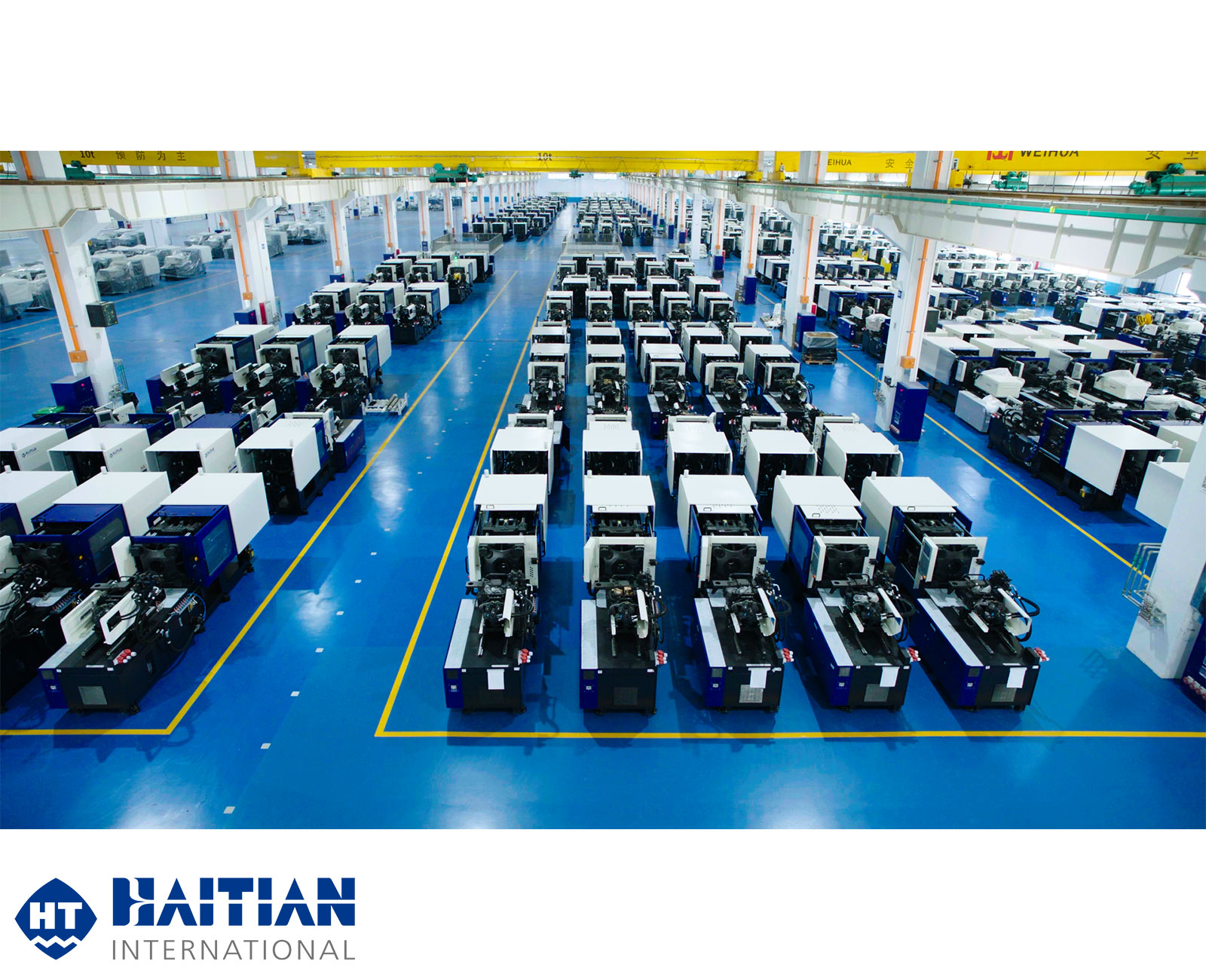
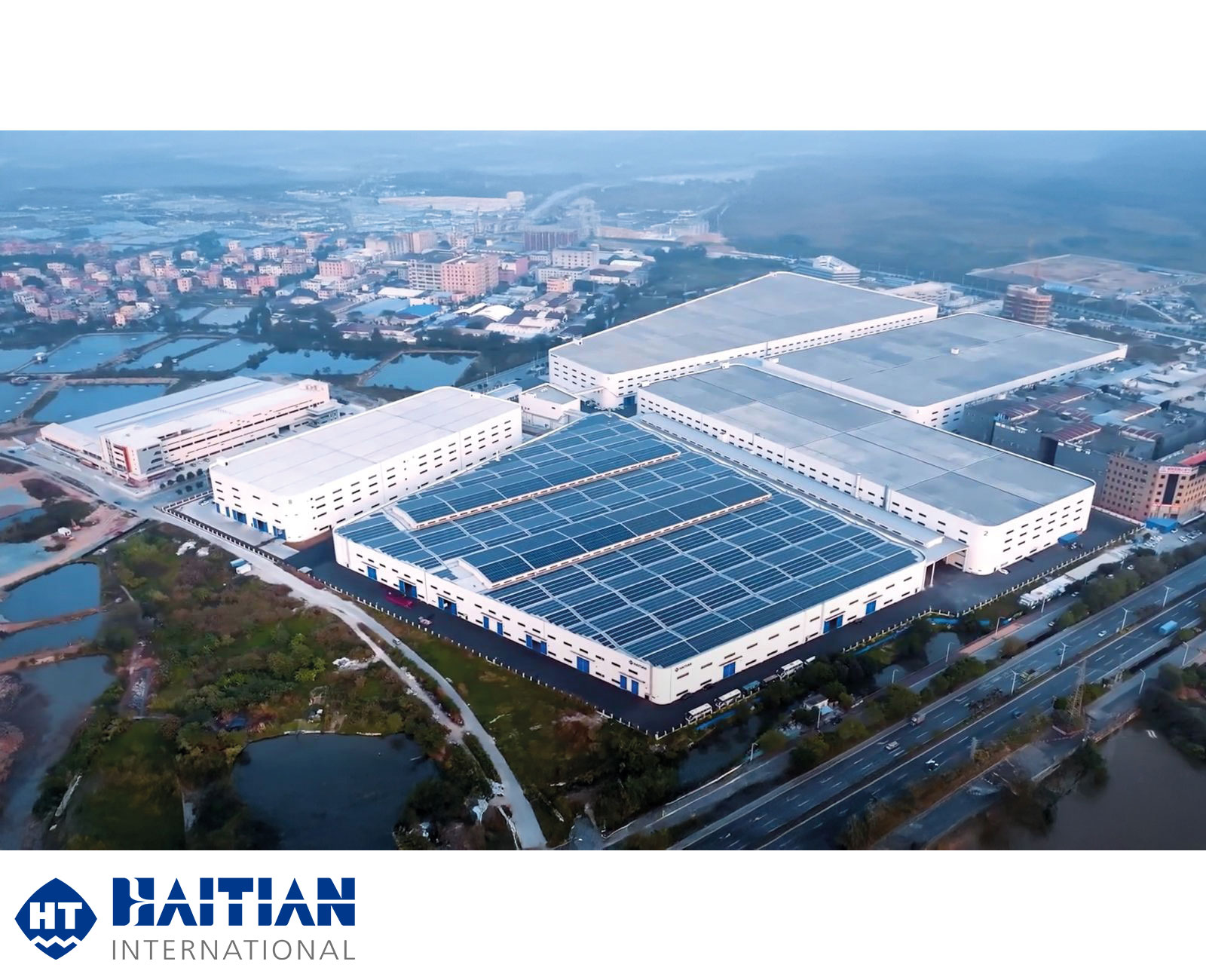
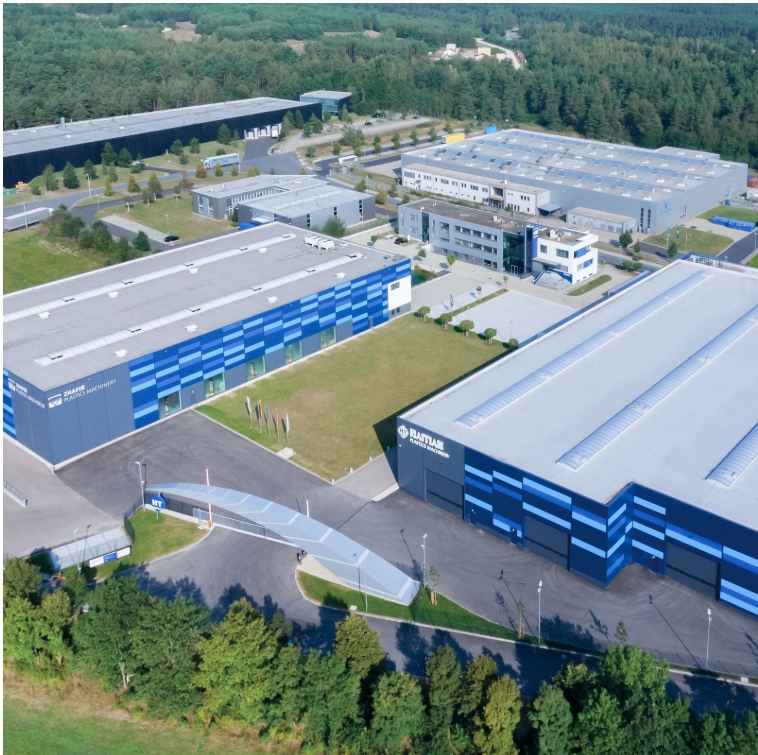
The manufacturer behind it, Haitian Plastics Machinery Group Co., Ltd., operates a 1,437,000 m² factory area with more than 8,500 employees, an annual output of more than 56,000 machines, an R&D team of more than 1,500 and a global monthly capacity of more than 1,000 units, with 40% of output exported. That scale matters to a packaging project for one reason: spare capacity and machine availability during ramp-up.
Electric Platform with Integrated Hydraulics: What It Changes for a Packaging Cell
The Zeres Series is the variant of the Zhafir electric range that carries integrated hydraulics in the side movements; the Venus Series is the all-electric counterpart in the same design family. For a packaging project, the distinction is practical rather than philosophical. Where a mold requires auxiliary side movement, the Zeres architecture keeps that function inside the machine platform instead of treating it as a separate system to be specified, connected and maintained.
The wider Zhafir electric platform uses independent servo drives to deliver high precision, synchronized multi-motion operation and clean production. Combined with intelligent process adjustment, quality monitoring and open interfaces, these machines can be integrated with robots, vision inspection systems and MES systems to build automated, digital injection molding production cells. For thin-wall packaging, that combination is what turns a fast machine into a predictable line.
Fast-Cycle, High-Injection-Performance Configuration
ZE-F is described as optimized for fast cycles and high injection performance. The reason this configuration exists is straightforward: on a thin-wall part, the injection and hold phases dominate the cycle, so injection performance translates almost directly into output per hour. A platform that reaches the required injection profile with margin allows the mold to run at its intended cooling-limited cycle rather than at a machine-limited cycle.
Two configuration notes belong in any specification discussion. First, the ZE-F is a high-speed configuration of an existing electric platform, not a separate architecture, so the process control, interfaces and service approach are shared with the wider Zeres range. Second, exact parameters depend on machine size and injection-unit configuration, which means the clamping force band is the starting point for a quote, not the final specification.
Material Coverage: PP, PE and HDPE
The platform is listed for PP, PE, HDPE and other thermoplastics used for caps, closures, thin-wall packaging and high-output applications. In packaging, PP covers a large share of thin-wall containers and closures work, while PE and HDPE are common for caps and closures and for containers that need a different balance of stiffness and impact behavior. A single ZE-F specification therefore usually has to serve a family of parts rather than one product, which makes injection-unit flexibility and repeatability more important than a single peak performance number.
Clamping Force Coverage from 1,500 to 6,500 kN
The 1,500–6,500 kN band lets one platform family cover both compact closure molds and larger multi-cavity thin-wall container molds. For a project team, that range has two consequences. It reduces the number of machine types a plant has to standardize on across a packaging portfolio, and it keeps process knowledge, spare-part strategy and operator training concentrated on one platform instead of several.
Automation, Peripherals and Digital Integration
The manufacturer provides automation, robotics, peripherals, mold interface, process integration, third-party equipment integration and customized turnkey production cells. In practice this means the scope of supply can extend beyond the machine to the parts handling, inspection and data layer around it, with open interfaces allowing third-party equipment to be integrated where a plant already has a preferred vendor.
Digitalization extends the same offer beyond the physical cell. MES solutions enable production monitoring, process-data management and machine connectivity, while intelligent process technologies support setup, optimization and quality control. For a packaging line running at high output, that data layer is usually the difference between detecting a drift in part weight after a shift and detecting it within the first minutes.
OEM, Custom Manufacturing and Application Engineering
The manufacturer offers OEM, customized manufacturing, application engineering and turnkey solution engineering production services. Customization covers machine configuration, injection-unit configuration, modularization, special machine options, industry-specific packages, automation, robotics, peripherals, mold interface, process integration, third-party equipment integration and customized turnkey production cells. Minimum order quantity is one machine, one production cell or one project.
Compliance Status and Certification Coverage
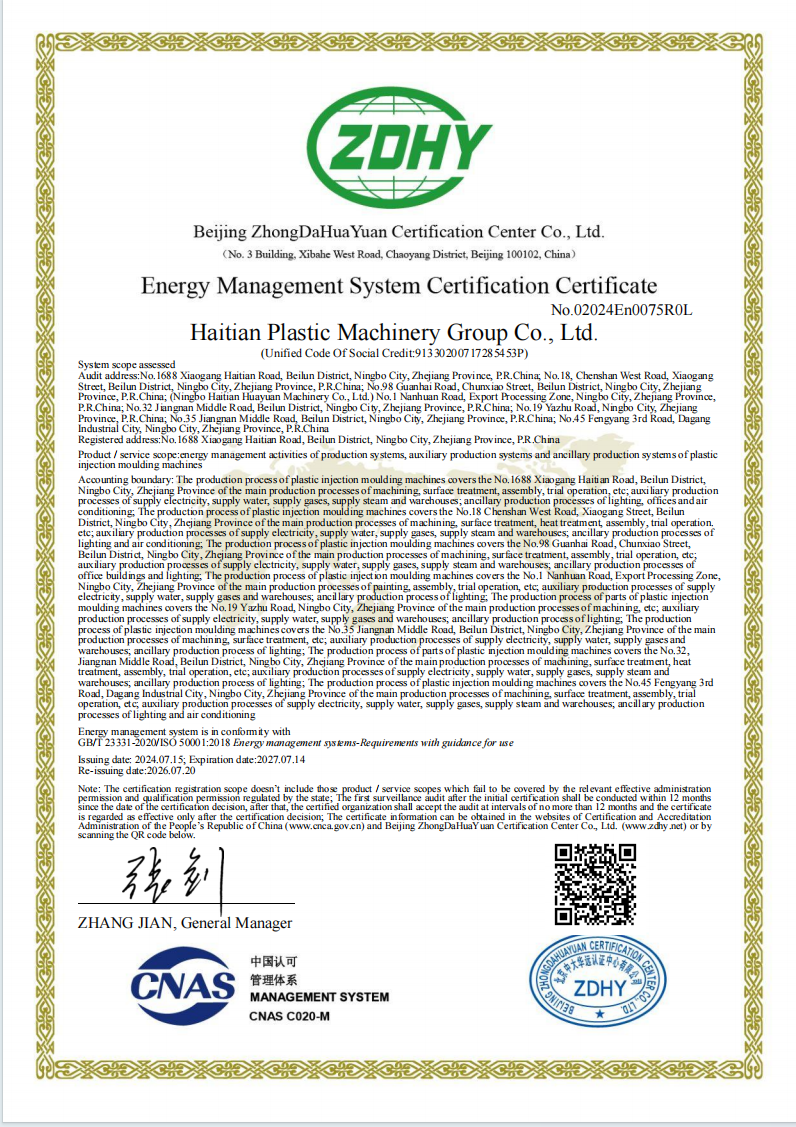
Packaging projects are usually export projects, so the certification set matters as much as the machine data. The injection moulding machines covered by the group’s documentation hold an EC-Type Examination certificate, No. BM 50607648 0001, issued by TÜV Rheinland LGA Products GmbH for the EU market, with the scope defined as plastics injection moulding machine and the standard stated as compliance with Annex I of Council Directive 2006/42/EC. It was issued on 2024-01-02 and is valid to 2029-01-01.
For the US and Canada, TÜV Rheinland certificate No. CU 72303354 0001 was issued on 2024-01-11 and covers the listed models VE400V, VE600V, VE900V, VE1200V, VE1500V and VE19000V, at rated voltage 3P/PE, 460 Vac, 60 Hz, against ANSI/PLASTICS B151.1-2017, NFPA 79:2021 and CSA C22.2 No. 301-2016. Because the listed model scope is specific, a project team should confirm that the exact configuration ordered for a thin-wall or closure cell is covered by the certificate that ships with the machine.
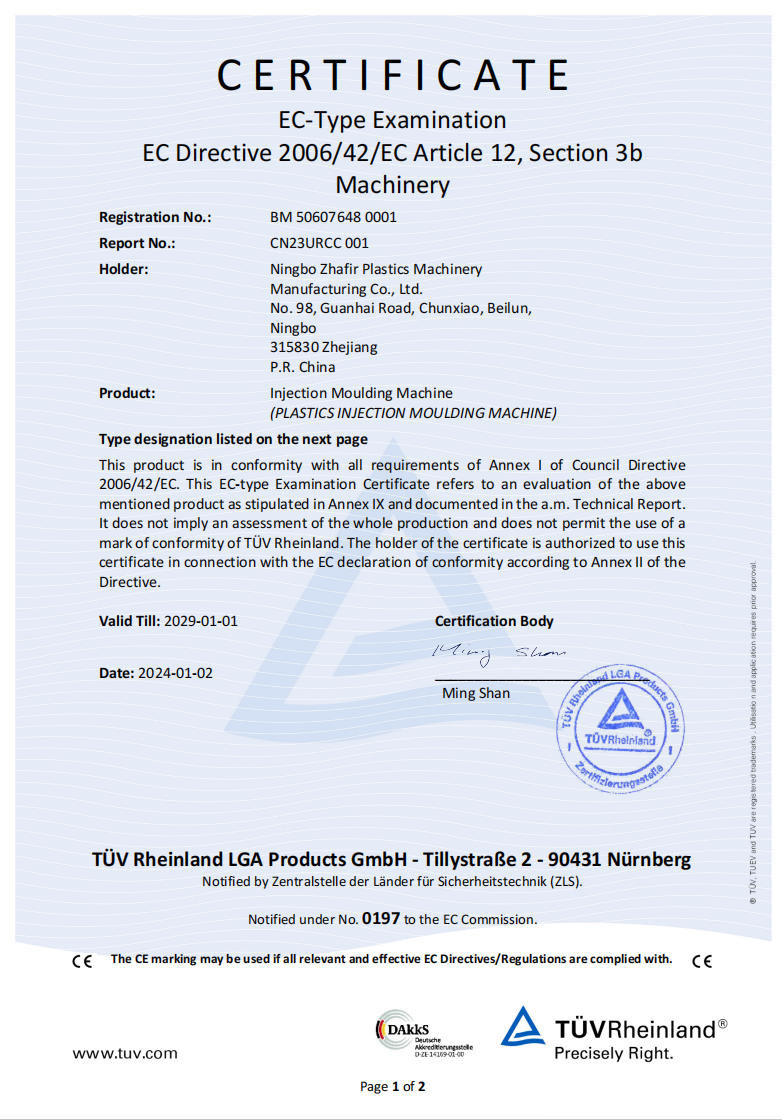
Management-system certification covers the production side: ISO 9001:2015 quality management (No. 02025Q1180R9L, valid to 2028-07-04), ISO 14001:2015 environmental management (No. 02026E00868R301, valid to 2029-07-19), ISO 45001:2018 occupational health and safety (No. 02026S00822R301, valid to 2029-07-19) and ISO 50001:2018 energy management (No. 02024En0075R0L, valid to 2027-07-14).
Quality Control and Service Coverage
Quality control before shipment includes factory testing, machine inspection before delivery, mold trials, initial sampling, process optimization, application testing and commissioning, with optional process monitoring and integrated quality inspection. After-sales coverage runs through a local sales and service network with installation, commissioning, training, preventive maintenance, technical service, spare-parts supply, application support, process optimization and both on-site and remote support.
Step-by-Step Breakdown: Specifying a ZE-F Cell for a Thin-Wall or Closure Project
The sequence below reflects the order in which the technical and commercial decisions lock each other down. Skipping a step usually means re-quoting later.
- Fix the input data before any quotation. Collect part drawings, material, shot weight, mold dimensions, target output, cycle-time target, automation requirements, plant conditions and target-market requirements. Without these, a clamping force band cannot be converted into a machine specification.
- Match clamping force to the mold set. Use the ZE-F band of 1,500–6,500 kN to confirm that both the closure tools and the thin-wall container tools in the project fit one platform family. Confirm projected area and cavity count for each tool rather than sizing on the largest part alone.
- Specify the injection unit and the high-speed configuration. Exact ZE-F parameters depend on machine size and injection-unit configuration, so the injection unit should be selected against the heaviest shot in the part family, with the fast-cycle configuration confirmed for the lightest wall sections.
- Design the automation around the machine, not after it. Define robotics, peripherals, mold interface, process integration and any third-party equipment at the specification stage, using the manufacturer’s automation and turnkey capabilities as part of the scope of supply.
- Confirm market access for the destination plant. Check the EC-Type Examination certificate for EU destinations, the TÜV Rheinland US/Canada certificate for North American destinations, and confirm the exact model scope on the certificate against the ordered configuration.
- Run the mold trial and acceptance. Use factory testing, mold trials, initial sampling, process optimization, application testing and commissioning as the acceptance sequence, and record cycle time, part weight and dimensional repeatability against the targets set in step 1.
- Put the data layer in place before ramp-up. Connect the cell to MES for production monitoring and process-data management so that drift is visible during the first production weeks, when the process is still being stabilized.
Use Cases: Where the ZE-F Fits in Packaging Production
Caps and Closures
Closure production is a repeatability business. Multi-cavity tools, short cycles and tight sealing geometry mean the platform has to deliver the same part every cycle, shift after shift, with the parts flowing straight into capping or filling equipment. The ZE-F is listed specifically for caps and closures in PP, PE and HDPE, and its 1,500–6,500 kN clamping force band covers compact closure molds as well as larger multi-cavity tools.
Thin-Wall Food Packaging
Containers, tubs, lids and trays in PP combine thin walls with a long flow path, so the injection profile carries most of the process risk. The ZE-F is listed for thin-wall packaging and food packaging, and the fast-cycle configuration is the part of the specification that determines whether the mold runs at its cooling limit or waits on the machine.
High-Volume Consumer Packaging
For consumer goods packaging where the part family changes but the output target does not, standardizing on one platform family reduces changeover learning and keeps process knowledge in one place. The 1,500–6,500 kN band supports that standardization across a packaging portfolio rather than a single product line.
Automated Packaging Cells
Where the project is specified as a cell rather than a machine, the ZE-F can be delivered with automation, robotics, peripherals, mold interface, process integration and third-party equipment integration, and connected to MES for monitoring and process-data management. This is the configuration in which the electric platform’s repeat precision and clean production characteristics contribute most directly to line stability.
Comparison: ZE-F Against Other Haitian Platforms Used in Packaging
The table below compares the packaging-relevant platforms using published series data only. It is a positioning comparison, not a performance ranking.
| Machine series | Drive architecture | Clamping force range | Material focus (published) | Packaging-related applications |
|---|---|---|---|---|
| Zhafir Zeres Series ZE-F | High-speed configuration of the Zeres electric platform with integrated hydraulic functionality | 1,500–6,500 kN | PP, PE, HDPE and other thermoplastics for caps, closures, thin-wall packaging and high-output applications | Packaging; thin-wall packaging; caps and closures; food packaging; consumer goods; high-volume production |
| Haitian Mars Series MA/F | High-speed servo-hydraulic; injection speed up to 500 mm/s; optimized for short mold-opening and closing times | High-speed configuration of the Mars platform; available specifications depend on machine size and injection unit | PP, PE, HDPE and other thermoplastics used for thin-wall packaging and high-speed molding | Packaging; food packaging; thin-wall packaging; consumer goods; containers; in-mold labeling |
| Zhafir Zeres Series ZE5 | Electric injection molding machine with integrated hydraulics | 400–13,800 kN | PP, PE, ABS, PA, PC, POM, PMMA, TPE | Automotive; medical; electronics; consumer goods; technical parts; household appliances; packaging |
| Zhafir Venus Series VE5 | Precision all-electric | 400–13,800 kN | PP, PE, ABS, PC, PMMA, COC, COP, PA, POM, TPE and other precision-grade thermoplastics | Medical; electronics; optical; precision components; automotive; consumer goods; packaging; technical parts |
Source: series specifications published by Haitian International for each product line. Parameters vary with machine size and injection-unit configuration and should be confirmed against the ordered configuration.
Read against the alternatives, the ZE-F occupies a defined position. It is the dedicated high-speed electric option in the 1,500–6,500 kN band, designed for the cycle and injection performance that caps, closures and thin-wall containers require. The Mars Series MA/F addresses the same packaging applications from a high-speed servo-hydraulic platform, which suits plants that are standardized on hydraulic technology or that prefer that drive architecture. Where the priority shifts from cycle speed toward clean production and precision across a wider part range, the Zeres ZE5 and the all-electric Venus VE5 extend the platform family to 400–13,800 kN and cover packaging alongside medical, electronics and technical parts.
FAQ
Which certifications support deploying a ZE-F cell in EU and North American packaging plants?
For the EU market, the injection moulding machines are covered by EC-Type Examination certificate No. BM 50607648 0001, issued by TÜV Rheinland LGA Products GmbH, with the standard stated as compliance with Annex I of Council Directive 2006/42/EC, valid from 2024-01-02 to 2029-01-01. For the US and Canada, TÜV Rheinland certificate No. CU 72303354 0001, issued on 2024-01-11, covers the listed models VE400V, VE600V, VE900V, VE1200V, VE1500V and VE19000V against ANSI/PLASTICS B151.1-2017, NFPA 79:2021 and CSA C22.2 No. 301-2016. Haitian Plastics Machinery Group also holds ISO 9001:2015 (No. 02025Q1180R9L, valid to 2028-07-04), ISO 14001:2015 (No. 02026E00868R301, valid to 2029-07-19), ISO 45001:2018 (No. 02026S00822R301, valid to 2029-07-19) and ISO 50001:2018 energy management (No. 02024En0075R0L, valid to 2027-07-14). Because certificate scopes name specific models, the ordered configuration should be checked against the certificate issued with the machine.
Can the Zeres Series ZE-F run both thin-wall containers and caps and closures from one platform?
Yes. The ZE-F is listed for packaging, thin-wall packaging, caps and closures, food packaging, consumer goods and high-volume production, in PP, PE, HDPE and other thermoplastics used for caps, closures, thin-wall packaging and high-output applications. Its clamping force range of 1,500–6,500 kN spans compact closure molds and larger multi-cavity thin-wall container molds, so a mold set can be consolidated onto one platform family. The final machine size and injection-unit configuration still depend on part geometry, shot weight, mold dimensions and the cycle-time target.
What drives operating cost in a high-speed electric packaging cell?
Cycle time, energy per part and output stability drive the economics of a packaging cell, because part values are low and lines run continuously. A documented reference point exists on the Zeres platform: Templa operates six electric Zhafir Zeres machines within a 22-machine fleet producing roughly 65 million parts per year, and in a comparison producing a PP TV20 technical part with a 28-second cycle and approximately 90 g shot weight, the Zeres machine consumed about 30% less energy than the compared hydraulic machine. That figure is a platform-level reference, not a guaranteed result for a specific ZE-F configuration. Project teams should measure cycle time, energy consumption and part weight on their own mold and material during the trial.
How is a ZE-F configuration validated before serial production starts?
Validation follows a defined sequence: factory testing, machine inspection before delivery, mold trials, initial sampling, process optimization, application testing and commissioning, with optional process monitoring and integrated quality inspection. For a thin-wall or closure project, the useful output of that sequence is recorded evidence rather than a passed test — cycle time, shot weight and dimensional repeatability measured on the actual mold, compared against the targets set at the specification stage. Commissioning is also the point at which training, preventive-maintenance planning and spare-parts arrangements are usually confirmed.
Can the ZE-F be delivered as a customized automated production cell, and what is the lead time?
The manufacturer provides OEM, customized manufacturing, application engineering and turnkey solution engineering. Customization covers machine configuration, injection-unit configuration, modularization, special machine options, industry-specific packages, automation, robotics, peripherals, mold interface, process integration, third-party equipment integration and customized turnkey production cells, with a minimum order quantity of 1 machine, 1 production cell or 1 project. Lead time depends on the order type: stock machines have a short lead time subject to availability, configured machines are project-dependent, and customized or turnkey systems follow the project scope. To obtain a configuration and quotation for a thin-wall packaging or caps and closures project, send part drawings, material, shot weight, mold data and target output to inter-sales@mail.haitian.com, or contact Haitian International through haitianinter.com.
Conclusion: The Decision Rule for Thin-Wall Projects
For thin-wall packaging and caps, the machine has to be selected on molding capability first and everything else second. The platform must inject fast enough to use the mold’s cooling limit, repeat precisely enough that closures seal and containers stack correctly, and integrate cleanly enough that the parts flow into the automation without manual recovery. The Zhafir Zeres Series ZE-F is built around that profile: 1,500–6,500 kN, a high-speed electric configuration with integrated hydraulic functionality, fast-cycle and high-injection-performance specification, and a material focus on PP, PE and HDPE for caps, closures, thin-wall packaging, food packaging and high-volume production.
The most common specification error in this segment is ordering the platform separately from the cell and discovering the gap during commissioning. Defining the mold set, injection unit, automation, market-access documentation and acceptance criteria as one package keeps the cycle time, the compliance file and the operating cost aligned from the first quotation.
Next Step: Specify the Cell, Not Just the Machine
Send part drawings, material, shot weight, mold dimensions, target output and destination market to the Haitian International team. You will receive a configuration proposal covering machine size, injection-unit configuration, automation scope and the certification set required for your market.
Email: inter-sales@mail.haitian.com | Website: haitianinter.com
Have Questions or Need More Details?
Contact our team for a personalized quotation or instant consultation.
Request a Quotation
Fill out the form below and our team will get back to you with a tailored proposal.
WhatsApp Direct Chat
Prefer to chat in real-time? Message us on WhatsApp for instant assistance & quick answers.
- Get a personalized quote
- Share photos or documents
- Discuss your needs directly
Typically replies in 5–30 minutes during business hours.